

🥇 A Strategy pode quebrar o Bitcoin?
Como o maior detentor de bitcoins pode se tornar seu maior vendedor

[PT]
Desde que a estratégia de Michael Saylor passou de vender ações e dívidas conversíveis para incluir ações preferenciais e pagamentos determinados de dividendos tenho ficado mais e mais incomodado com isso.
O report que segue é uma expressao dessa preocupação. No “The Strategy Risk”, da Fintrender, trazemos uma coisa rara nesse mercado, que eh olhar para a Strategy (a antiga MicroStrategy) sem torcida, e com análise baseada em artigos academicos.
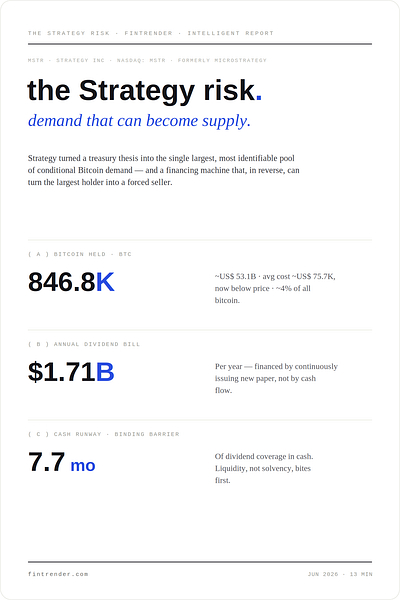
A tese é de que o risco da Strategy não está na solvência. Para a empresa de fato quebrar, o Bitcoin precisaria cair quase 60%, até perto de US$ 25 mil. Esse muro está longe, e quase ninguém deveria perder sono com ele. Então onde mora o problema de verdade?
No fluxo. A conta anual de dividendos, algo perto de US$ 1,7 bilhão, não é paga com caixa. É paga emitindo papel novo o tempo todo, e isso só funciona enquanto o mercado aceita pagar um prêmio por esses instrumentos. Quando o prêmio some, como já está acontecendo no depeg do STRC, a máquina de financiamento trava muito antes de qualquer conversa sobre insolvência. O caixa cobre os dividendos por uns sete meses apenas.
Aí vem a parte complicada. A Strategy detém cerca de 4% de todo o Bitcoin que existe, a um custo médio acima do preço de hoje. Se o canal de emissão fecha, o dividendo passa a ser honrado vendendo Bitcoin abaixo do custo. Ou seja, o maior comprador da história vira um vendedor mecânico e perfeitamente identificável, e aparece vendendo justamente quando o mercado já está fraco. O prêmio que um dia empurrou o Bitcoin para cima vira a oferta que o pressiona para baixo.
Você consegue imaginar combinação mais reflexiva que essa?
Baixe o report inteiro acima para muito mais detalhes e depois me conta o que achou, adoraria destrinchar as implicações com você.
Abcs,
Gustavo Cunha
—
[EN]
Ever since Michael Saylor’s strategy moved beyond issuing stock and convertible debt to include preferred shares and fixed dividend payments, I’ve grown more and more uneasy about it.
The report below is an expression of that concern. In “The Strategy Risk,” from Fintrender, we bring something rare to this market: a look at Strategy (the former MicroStrategy) without any rooting interest, grounded in academic papers about what might come next.
The thesis is that Strategy’s risk doesn’t lie in solvency. For the company to actually go under, Bitcoin would have to fall nearly 60%, down to around US$25,000. That wall is far away, and almost no one should be losing sleep over it. So where does the real problem live?
In the flow. The annual dividend bill, something close to US$1.7 billion, isn’t paid out of cash. It’s paid by issuing new paper all the time, and that only works as long as the market is willing to pay a premium for those instruments. When the premium disappears, as is already happening in the STRC depeg, the financing machine jams long before any conversation about insolvency. Cash covers the dividends for only about seven months.
And here comes the tricky part. Strategy holds roughly 4% of all the Bitcoin that exists, at an average cost above today’s price. If the issuance channel shuts down, the dividend ends up being honored by selling Bitcoin below cost. In other words, the largest buyer in history becomes a mechanical, perfectly identifiable seller, and shows up selling precisely when the market is already weak. The premium that once pushed Bitcoin up becomes the supply that pushes it down.
Can you imagine a more reflexive combination than that?
Strategy Fintrender Intelligent Report 5.7MB ∙ PDF file Download
The Strategy Risk — Why the largest Bitcoin holder, financed by issuance rather than cash flow, could flip from buyer to forced seller and pressure the very market it once lifted. Download
Download the full report above for far more detail, and then let me know what you think. I’d love to dig into the implications with you.
Best,
Gustavo Cunha
Seguimos em contato pelos links abaixo:
Fintrender.com, YouTube, LinkedIn, Instagram, Twitter, Facebook e podcast Fintrender